
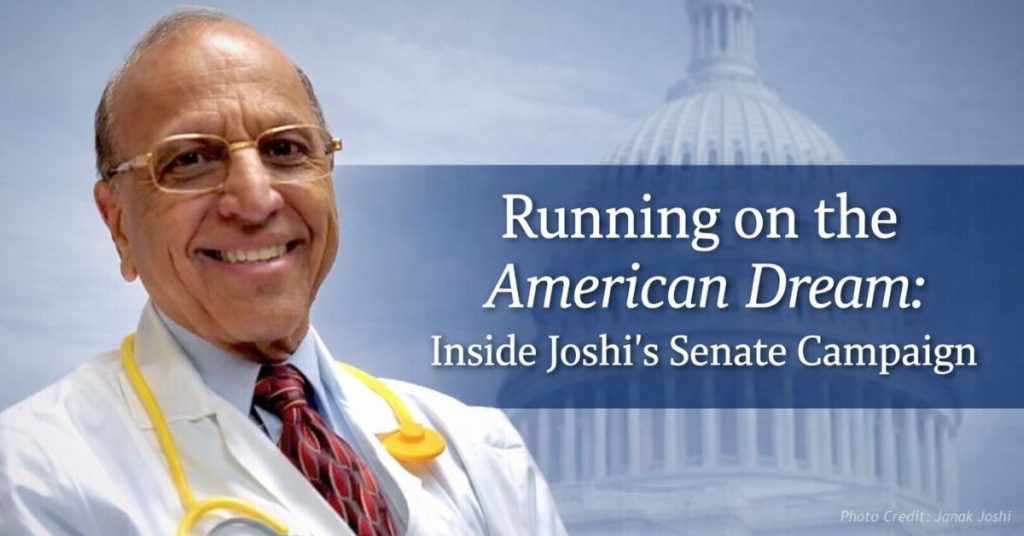
By Shaina Cole | Contributing Writer, Rocky Mountain Voice
Dr. Janak Joshi is back on the campaign trail — this time seeking the Republican nomination for U.S. Senate. The physician and former state legislator is entering Colorado’s caucus process, which begins March 3, ahead of district and state assemblies and the June primary.
When asked why he entered the race, his answer centered less on political ambition and more on concern — about affordability, opportunity and what kind of country future generations will inherit.
“I am running for US Senate because we are seeing that the Democrats, and particularly the liberals, haven’t done much in the last five years to help in any way to Colorado and as a country.”
He spoke about rising costs, businesses closing and the difficulty many families face in buying homes or running small operations. But for him, the decision carries a personal dimension.
“Not for fame or money, but to make sure that American dream survives for our future generations.”
Family, he said, sharpens that urgency.
“Particularly when you have grandchildren you kind of worry about it… about their future.”
Joshi frequently speaks about his own experience, moving to the United States with limited resources and taking many years to establish himself in the medical field. He claims he has lived the American Dream but fears that it is becoming increasingly difficult for others to attain.
Immigration Through a Personal Lens
Having arrived in the United States more than 50 years ago, Dr. Joshi’s immigration experience shapes how he approaches border policy today.
“When I came over 50 years ago… those laws that we had to follow, they are still in effect. We just don’t follow them anymore.”
He described the legal requirements he completed at the time — medical exams, documentation, sponsorship agreements — and argued that the structure of immigration law has not disappeared, but enforcement has weakened.
“All these laws are there. They are on the books.”
Rather than proposing new federal statutes, he says the focus should be implementation.
“Now these people just walk through the open border and then immediately demand that we support them.”
At the same time, he draws a distinction between illegal entry and lawful immigration.
“As long as they want to come here and go through the proper channels…pay the taxes, and behave like a very civil person and assimilate in the society–we don’t have a problem.”
He points to his own experience as evidence that legal immigration and assimilation can strengthen the country.
“I’m the prime example.”
For Joshi, enforcement is less about shutting doors and more about restoring order to a system he believes already exists in law.
Regulation, Licensing and the Cost of Complexity
On economic policy, Joshi repeatedly returns to the structure of government itself. He argues that over time, rules and administrative requirements have layered onto one another in ways that make everyday economic participation harder — even for people with decades of experience.
“My basic principles are smaller government, lower taxes, and less regulation.”
He cited professionals, for instance, who already have training and experience, but face obstacles in applying what they know in a different way.
During the interview, he described retired physicians who might want to teach biology, skilled tradesmen who might want to consult or work part-time, and experienced individuals who still face licensing hurdles that limit their ability to contribute.
“Regulation is one of the biggest problems.”
In his view, the issue is not standards themselves, but rigidity — systems that fail to distinguish between protecting the public and unnecessarily restricting qualified people.
He also criticized what he sees as a growing reliance on fees instead of transparent taxation.
“We have these fees which are nothing more than taxes.”
To Joshi, that layering of charges — often attached quietly to permits, professional requirements or business compliance — makes long-term planning difficult for small operators.
In addition to individual licensing, he stated that regulatory frameworks can impede development and increase costs for consumers. He cited long approval times and structures of liabilities that, in his view, slow down the development of housing.
He also believes that lawmakers do not always foresee the consequences of their decisions.
“Sometimes there are domino effects which we don’t even think about.”
Rather than creating new oversight mechanisms to correct past policies, Joshi says the government should reassess what already exists.
“We have to simplify the system–in short–at every level of the government.”
For him, simplifying the system means removing unnecessary layers, making the rules straightforward and allowing people to build something without being slowed at every step by government process.
Budget Discipline as a Central Goal
If elected, Joshi says fiscal restraint would define his time in Washington. He repeatedly returned to the federal budget as the foundation of nearly every other economic problem — from inflation to interest rates to long-term stability.
“I would definitely like to bring the budget down or at least get rid of the fraud and abuse in the system and bring all that money back to the taxpayer’s pocket.”
He framed the issue in practical terms. In his view, government spending often lacks the accountability that families exercise in their own households. When costs rise at home, people cut back. He believes Washington should operate under a similar principle.
“I really want to be my legacy as bringing it down and if we do that I think everything else follows.”
For Joshi, stabilizing spending would ease inflationary pressure, lower interest burdens and allow taxpayers to keep more of what they earn.
Experience Across the Aisle
Although he identifies as a fiscal conservative, Joshi says holding firm beliefs doesn’t require constant confrontation. He has worked regularly with Democrats during his six years in the Colorado House of Representatives, he said.
“I never had any problem going across the aisle… and getting bills passed.”
He noted that many of his successful bills have had Democratic co-sponsors and that they passed because they are “good bills.”
“My bills were mostly passed unanimously because they were good bills.”
He acknowledged that proposals centered on cutting taxes often stalled, but said other legislation gained traction when framed in terms colleagues across the political spectrum could accept.
He also emphasized that tone matters in legislative work.
“If you are good at presenting your case… in a more civil way as well as a more logical way… at least you make people think about it.”
Joshi attributes that approach in part to his background in medicine, where he said working with people from different professions, faiths and cultural backgrounds was a daily reality. He believes that experience shaped how he navigates political disagreements — not by abandoning core principles, but by persuading others through what he calls a “civil” and “logical” argument.
Faith and Public Life
Joshi does not separate his faith from his political identity. When discussing his motivations, he ties policy positions to moral convictions he says were shaped long before he entered public office.
“As a physician I am also a supporter of life, and dignity of life is very important to me.”
During his time in the legislature, he helped organize a weekly Bible study at the Capitol, describing it as a way to pause from partisan debate and focus on shared responsibility.
“We all, every morning, prayed for each other and for our state and country.”
That emphasis on faith and service was echoed in a recent Rocky Mountain Voice commentary piece highlighting his leadership style. One supporter wrote:
“Having served with Dr. Joshi I know he is the perfect example of servant leadership… he treats everyone with dignity and kindness, while refusing to compromise his values and principles.”
The same piece described his faith as central to his public life:
“It’s evident to anyone who knows him that his strong faith and patriotism drive his passion and commitment to protecting Colorado families… defending the unborn, and standing strong for our Constitutional liberties.”
With precinct caucuses beginning March 3 and assemblies to follow, Republican voters will determine which candidates advance to the June primary ballot. The statewide primary will ultimately decide the party’s nominee for the general election.